Friday, November 12, 2010

A Different Lifestyle

A Different Life Style

Thanks to Pastor Randy’s suggestion I have read The Good and Beautiful God and I am in the middle of The Good and Beautiful Life. Both of these books are written by James Bryan Smith. The goal of the first book is to make known God as Jesus knew Him, so that we may fall in love with Him. The goal of the second book is putting on the character of Christ.

The part of the books that has affected me the most are the exercises of spiritual disciplines. I am amazed that I am reading them here in Slovakia where these exercises have fit in so well with the life style here.

One of the disciplines is that of “Silence and the Awareness of Creation”. Here where I do not know the language I do not have the radio or TV on, so when I am alone in the flat, I am able to experience silence. In this different climate I find myself paying more attention to God’s creation and enjoying it.


The autumn changes in the square.

Then there is the discipline of putting margins or times without commitment in one’s life to replace “hurry sickness.” This makes room to enjoy life and to communicate with God in the middle of life’s business. Although people here say they haven’t done something because they are too busy, I see them making time in their days to eat dinner with their families, listen to a friend who needs some support and play with their children. They are making margins in their lives.

In the chapter about anger, the author speaks of the causes of anger, such as unmet expectations, not having control, and fear. I know that I am NOT in control of all the events in my life. I am only in control of my reactions to these events. A case in point is the fact that I have not been given the necessary VISA. What will happen? I know that at this point, I have no control over my VISA. What is going to happen? I don’t know. But I do know who is in control. I believe this is a discipline for me to give God the problem and leave it in His hands. Even if I am sent away from this beautiful country, I thank God for the blessings we have had here so far.

The spiritual discipline to help with anger is “Keeping the Sabbath.” Keeping the Sabbath is to trust in God and letting go of control of this part of life. As I read the details, I think that this is a wonderful place to try this discipline. On Saturdays, between 11:00 AM and noon, the stores close for the weekend. I don’t mean that some of them, I mean ALL of the stores and shops on the square close. There are only two restaurants open and the grocery store at the end of the square stays open until 4 or 5 PM, but everything else is closed. Here, the weekends are for families. Sunday’s meal is definitely a family affair.


This is the Martin Square at noon on Sunday.

We thank you, Heavenly Father, for leading us to this beautiful country, full of these beautiful, gracious people. Help us to grow where you would have us grow.
Continue to help us enjoy this country and the experiences we have here.

Saturday, November 6, 2010

Reformation Day and All Saints' Day


The last school day in October was on Thursday,
the 28th of October. One of the fourth grades
that I work with was finishing their plant
project. They grew grass from seeds.
They had kept certain conditions (such as
water or light) from their seeds and
recorded how their seeds grew.


The other fourth grade had a day off from the
English. Their teacher had divided the class into
groups. Each group was to make its own scarecrow.
I wish that I had room to show all of the scarecrows.
It was a great project for working together and being
original.


The last period of the day was spent in a special
church service for the students. The subject was
Reformation Day. A choir sang some songs, including
“Lord I Lift Your Name on High, complete with hand
motions. Then the children had a holiday
Friday, Monday and Tuesday for All Saints Day.


During the Sunday church service,
the seventh grade class had a great original
play about Martin Luther’s nailing the 95
thesis’s on the church door. I cannot think
of a better way to teach about the beginning
of the Reformation than having the students act it out.


And then there was All Saints’ Day,
Monday, 1st of November. This is a state holiday.
The whole weekend is a time for families
to gather at their grandparents or parents’ graves.
It is in some ways similar to the Day of the Dead.
For weeks, flowers and candles have been sold.


This is the day that families go to the cemeteries.
They weed and clean up around the grave of
their loved one(s). They take the old flowers,
arrangements and candles away. These are
replaced with new arrangements and candles are lit.


Practically every grave in the newer part of
the cemetery had flowers on it.
The flowers were as far as the eye could see.


After you take care of your family graves, they you go to the graves of persons special to you. This is the grave of Pastor Jan Bohdon Hrobon, the father of Pastor Jan Hrobon of the Evangelical Church in Martin, and Bohdon Hrobon, the founder of the Bible School.


Besides the candles on the graves, there were
a couple of locations in the cemetery that
more candles were lit. My guess is that these
are lit in memory of loved ones who are
buried elsewhere.

On the Second of November, Gary and I went to a small town of Ružomberok.
(That is another story.) On the way back, we passed by a couple of cemeteries.
It was after dark and the candles were still lit and they were spectacular.

An interesting side note for me is that this is a holiday that the Communist
Regime would allow. For some reason, they did not associate it with the
Church.

Tuesday, October 19, 2010

Reconnecting in Banska Bytrica


We were invited to spend the weekend in Banska Bystrica by one of Gary’s students, Zuzana, from 2004. We went Saturday morning because we did not want to miss The Truth Project that we were watching and discussing in our Friday night Bible Study.

The train ride was foggy at first, but when we reached the hills, it was sunny and the hills were full of fall colors. The train station had some beautiful stain glass windows, representing towns from the areas around Banska Bystrica.


Zuzana and her family live in a two story house that used to be in a village, but is now in Banska Bystrica. There is a creek running on the opposite side of the road from the house.

Zuzana’s mother had a wonderful dinner waiting for us when we got there. Her mother does not speak English, but she had worked several years in Italy. With her Italian and Jeannine’s Spanish, they were able to visit some.

When we got to the center of town, on Saturday afternoon, the town was closed, except for the churches (for weddings), restaurants and some museums. Unfortunately, the museum Zuzana wanted to show us was closed. So we walked through the square towards what used to be a castle. Now it is a restaurant. Then we passed two large Roman Catholic churches. One was for the Germans and the other was for the Slovaks. We passed a large tower, which used to be one of the watchtowers for the town. Around it was a cemetery.


From there, we went to an ice cream stand with the “best ice cream in Slovakia.” The stand was at the edge of a large city park, which was by the river. We could see the beautiful hills surrounding the town.

We wanted to visit the museum that looks like a Slovak hat cut n half. (Or a mushroom with its top sliced off.) I remember seeing the building in 2004, but I mainly remembered graffiti on its sides. It does not have graffiti now. It is in memoriam of the 1944 Slovak rebellion against the Germans. It was not successful, but is something Zuzana’s countrymen are proud of. I believe the museum also has exhibits of the Communist era. It was going to be closed in a half hour, so we saw the artillery and tanks that were used in WWII and the rebellion. They were outside in an open air museum.


We went to church with Zuzana, even though she would be teaching Sunday School and would not be there to interpret for us. That was fine with us, since we go to church on all Sundays without an interpreter in Martin. Before we went into the sanctuary, we met a woman who began speaking to us in English, when she found out we spoke English. When she had to stop to think of a word, she mentioned she had to think of it in Spanish, first, then English. She had spent three years in Peru, doing missionary work. So she and Jeannine spoke some more in Spanish.

The church service was similar to the ones here in Martin. But after the sermon, the prayers of the people and the blessings, the young people from Sunday School came in and sang to us. They did not just sing one song; they sang for about ten minutes. The joy of the Lord shown on their faces. When they finished, the praise-band stayed in front of the church. We were told that they sing for about an hour after the service. We do enjoy singing, so we stayed in the church. (The pastor came in when he had changed out of his official robes and really got into the praise singing, also. When Zuzana came, she wondered if we were wanted to leave. We answered that we wanted to do what she wanted to do. Well, maybe one song. We stayed for almost the whole second hour.


Zuzana tried to show us another museum, but it was closed for lunch. So we went home to another wonderful dinner with duck and cabbage and an apple cake. We did get to see the museum in the center of town; it had been closed on Saturday. Then we caught the train and were back in Martin in an hour.


Although we did not see many museums, we so enjoyed just visiting with Zuzana and her mother. We have invited Zuzana to Martin for a weekend of “English practice.”

Wednesday, October 6, 2010

Teaching at Evanjelicka Základna Skola


I teach English in lessons following the Content Language Integrated Lessons (CLIL) format. This is method that is used all over Europe where teaching a new language. In CLIL lessons the content is more important than the language taught. The content may be geography, math or science. It is to be “real subjects applicable to real life.”

The day begins at 7:40. There is sharing time, followed by prayer time. This prayer time is mainly the students praying, with a small addition to the prayers by the teacher. Then each class has 45 minute classes followed by 10 minute breaks. In the breaks, the students can eat, have a drink, play one in the classroom, read, use the WC (water closet). The students get loud and rowdy in some classes, but there seems to be enough of a break that the students keep their attention on the following slesson. There seems to be no outside recess in the mornings.

In the second grade, I have been teaching the names of different fruit and vegetables. I began o with real fruit and vegetables. I introduce pictures and then names to be paired with the “real” examples. Then they get to color their paper with examples. We make our own Bingo cards and
Play Bingo. I like to have the students draw the fruit so they can have practice saying the names.
Here is a picture of some of the second graders on their break.


In the third grade we have been working in math. Specifically, we have worked on odd and even numbers, greater than and less than, and rounding up and down. We have practiced ordering numbers, saying if their number is greater than or less than their neighbor’s number and deciding how we “round numbers.” An interesting game we have played is to have a number put on their backs and they have to ask questions (that can be answered with yes or no) to see if they can discover their number.
This is the inside of a third grade classroom.
I like the idea of having nets on the wall to display work or decorations in place of using bulletin boards.

In the fourth grade we have been working with compass directions and maps. The classroom teacher teaches the students about Slovak geography, using maps. I taught about geography in California. We read a map of part of California, finding cities by following instructions that include compass directions. We made a map of California, with mountains, lakes, rivers, bay, ocean and cities. Then the students played a similar game with California locations on their back and they ask yes and no questions. I like this game because it gets the students to use the language rather than just hear it. The final activity with maps was to have a student tell three items about a location in CA and the others try to guess that location.

Fourth graders playing the “Yes-No Game”


As always, when I’m in a class with the students, I feel at home.

Saturday, September 25, 2010

Harvest Festival

Looking at the calendar, I see it is the last weekend in September. We will be missing the Arroyo Grande Harvest Festival.


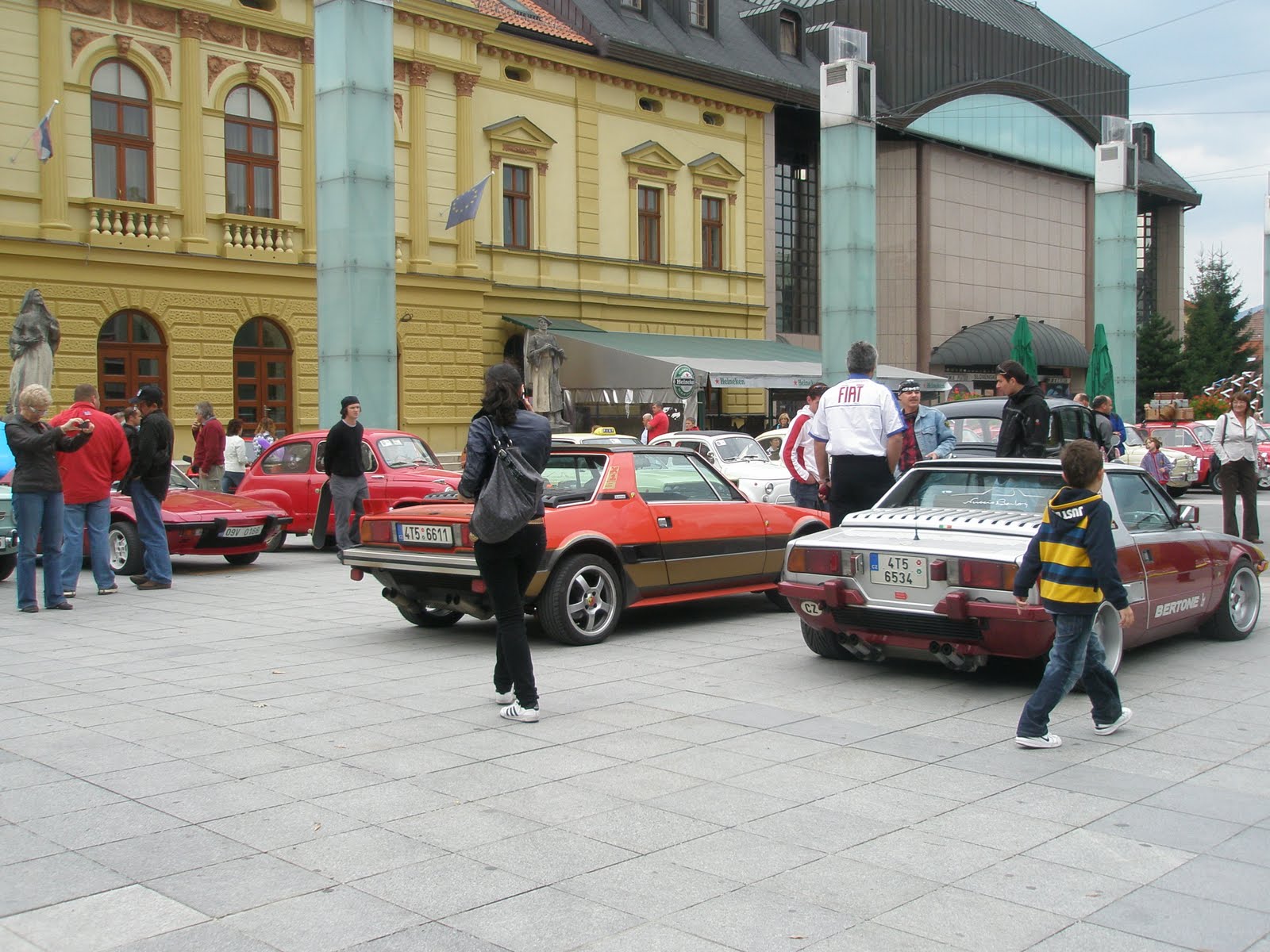
Today, Gary and I need to go to the farmers' market to buy fruit and house slippers. As soon as we get to the Centrum in the center of the square, we can hear music and see a group of older Fiats in the center of the square. Something out of the ordinary is definitely happening.


Yes, this is the Martin, Slovakia Harvest Festival.

When we get to one of the statues on the square we see a trampoline and gigantic slide for kids.


Then came the booths with handicrafts. Brightly colored, and homemade. Rugs that are handwoven, paintings, glass candle holders and angels, baskets and delicately decorated gingerbread cookies....pieces of art.


Then we got to the area in front of the Roman Catholic Church and encountered the FOOD! There is chicken, sausages, kabobs, and homemade tortilla-like bread. Then there is cotton candy, decorated cookies, candy, candy, candy.

The street between the church and the farmers' market is closed to auto and bus traffic. The street is full of booths with clothes, tablecloths, shoes, etc. Behind the market is the carnival.

And this is the Harvest Festival in Martin, Slovakia.

Friday, September 17, 2010

A Week in Martin

As I wake up this morning, hearing the gentle rain, I wonder how many rainy days we had this past week and begin thinking of all the things Gary and I have done this past week:

Last Friday night we had Larry and Brenda (from Vancouver, OR on their 2nd year here) for dinner. It had been raining most of the day.

Saturday: It’s still raining, so we have a rather lazy day with Gary working on chicken for broth and a chicken noodle soup. Brenda came by to retrieve her passport. Emily hears us talking and comes to ask if we wanted to get to and do needlecraft. That develops into a “happening.” We begin at our place with chicken noodle soup, homemade pita bread and chicken with the dumplings Brenda’s grandmother made from Brenda and Larry and a raspberry/apple pie freshly made by Emily. After dinner, Gary and Larry go to Larry’s flat to watch a DVD on the Bethlehem Star. Brenda does some cross stitch while Emily and I crochet.

Sunday: Early in the morning I hear it raining again. It is not raining when we go to church with Daniel. Daniel is a Scandinavian who is here for the med school. After church we go with him to have some coffee. On the way, we meet a friend of Daniel’s who is also from Sweden. He and Daniel have some “catching up” to do so he is naturally invited to accompany us for some coffee. His parents are from Iran and we learned some things about Iran and the different kinds of people living there.

When Daniel’s friend leaves, we go to the only restaurant open for a good Sunday dinner. Here he tells us that he is going back home because the he was not able to get the money for his med school. He is a firm Christian believer and feels that this is just not the time for him to study medicine. His plans are now to return to Sweden and study German for three years. (He had studied German before.) Then he believes he can go to Vienna to study medicine in German. Because the classes will be in the local language, there will be no tuition.

We walk around after that and then go to our flat to look at some maps. Daniel shows us where he has lived with his Norwegian parents in Sweden. Then he shows us some good places to visit, if we are able to go to Norway. He tells us that Christopherson is not a common name and that they were boat builders. Boat building was done outside Oslo so we may be able to find something there about Gary’s mother’s paternal family.
.

At 16,00 we go back to the church for a small band concert. There were five people: one played many stringed instruments including a banjo, one played alto and soprano saxophone, one got marvelous percussion sounds from a bongo-like drum and the wooden box he was sitting on. I thought he had a recording of brushes on a snare drum, but it all came from his “box.” The leader of the group played a guitar, but he also used his mouth as an instrument and could make two different notes at the same time! The fifth person of the group recited poetry. We could not tell if she was speaking Slovak or Hungarian, but the sound of her poetry and the music was very pleasant to the ear. They also included Tomaš, playing his harmonica a very interesting concert.

I ended up the day trying my voice in the church’s choir. It is led by Maria, Pastor Jan’s wife. Maybe 20 people were there, including both pastors.

Monday: The class day is made up of a ten minute opening that includes prayer. Then there are five 45 minute classes, separated by 10 minute breaks. The first period, I meet with a fourth grade teacher to plan what will be taught this week. Second period is with a second grade class. We practice introductions. Then I have two periods off in which I can work on fourth grade plans. Fifth period is the other second grade. I return to the flat to have lunch and at 13,00 I’m back to work with the third grade teachers. The rest of the day is free.

Tuesday: I begin with a third period class. I get there a little early and I am invited to the circle and to say a prayer. In the third grade we are comparing numbers. At 10,40 and 11,35 I teach geography in the fourth grade classes. That afternoon, I get my hair fixed at a salon. On the way back, I meet Bohdon who is with his young son. He casually mentions that the next day is a holiday, St Mary’s Day he believes. It is a national holiday. Is it a school day? He does not think so, but he really does not know. Luckily, as I come to the gymnasium, I meet three other teachers and ask them. Yes tomorrow is a free day.

Wednesday: When I tell Gary about the free day, he thinks we should go somewhere outside Martin and explore. We decide on Ružomberok. We could get to it by bus, maybe an hour with the other stops. We need to catch it at 9,45. However, when we get there, we discover that it was not the bus stop across from the train station, but the one across from the farmers market. So we cross the street and see where the train will take us. We decide on Trenčin. It is where the castle is that we saw as we were going from Bratislava and we stopped for a break in 2009

We walked through a very nice park, under a main road and find ourselves in the “old town.” It is just below the castle. It was steep walking to get to the castle, but well worth it. Unfortunately, we don’t walk as fast as the Slovaks do and we missed the guided tour through the palace. So we took our time going down, taking pictures as we went. We then looked to see what was opened for a bite to eat and found very little opened. We passed a couple of churches and found ourselves in another square with a running fountain and a synagogue. We knew it was no longer a place of worship, but an art gallery. It is closed today, being a national holiday. We did find a place with good pizza and another museum. Then we caught the train to It was a good day. (We rode through some rain, but did not get any on us the whole day.)

Thursday: Thursdays begin with two third grade number lessons. The next two periods are in the fourth grade with geography lessons. I go back to the flat to help Gary get ready for the weekend in Drienca, Sk. near the Tatras. So I buy some more time on our phones and finish the laundry, while he has a meeting with the school psychologist and a medical dr. who is interested in starting a group for alcoholics here at the school. (Interestingly this doctor wants nothing to do with God or a Higher power. We’ll see how it goes.) His friend is here at 16,00 and off they go.

So goes a week here in Martin, Slovakia for Gary and Jeannine.

Sunday, September 5, 2010

Poprod Adventure

When we got off the train in Poprad, we did not know where to go so we just picked a direction and went. With a little help from a person at a hotel desk, we found our way to an information office. Before we follow the directions to the “our” pension, we find a museum. It had some interesting exhibits including some of a Neanderthal camp discovered in the area. Very little in English so we did not take as long as we usually do in a museum.


On the way to the pension, we passed by a large mural that was done in small tile. It was commemorating the Russian “liberation” from the Germans at the end of World War II. From what our tour book says, it is one of the few about this event, which are still standing in Slovakia. You never know when and where you will find a piece of art like this.

That afternoon we found the bus to Spissky to see the castle there. This is one of the five largest castles in Europe. You can see it for miles. It is a long walk up to the castle, but well worth it. We were able to get an audio tour of the castle, including legends, in English. They each cost 10€, which was returned to us after we returned them.


The castle’s first walls were built in the twelfth century. From that time through the fourteenth century, owners kept adding to it. It is truly one of our favorite places that we have visited. This is definitely an example of pictures far exceeding words.


Sunday is a day when few places of businesses are opened. Luckily a few food places are.
That was the morning we had gyros for breakfast. As we were eating, we noticed that we could see the tips of the Tatras. I thought Gary got a relatively good picture of them.


The one other place we wished to see was “Old Town Poprod.” We had a couple of people help us get there. When we got there, we were able to get into the old church, (something we were not able to do with the other two churches in Poprod that were in our tour book.) The guide did not speak English, but had a good description of the inside. The rest of the town which we walked through had many picturesque houses that are dwellings.


Before getting on the train to return home, we visited an interesting building that had displays of art. The building, for us, was very interesting, much more than the modern art that was in it. One of the last pictures we took was in a construction area that was fenced off from the public, but it sure looked like a wagon of possibly some nomad Roma family.